
Residual value recovery (Restwertrückführung) bases remodel decisions in a store portfolio on the physical residual value of the fittings – not on their book value.
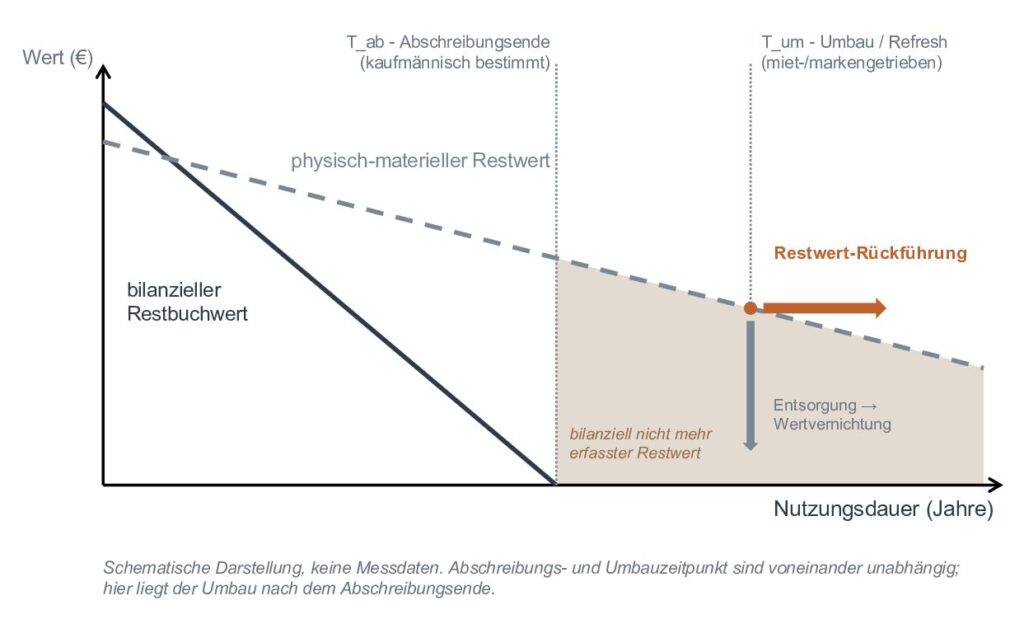
The end of depreciation (T_ab) and the actual remodel date (T_um) almost never coincide. That gap is where capital is destroyed.
Key takeaways
- Store fit-outs are depreciated under tax and accounting rules, usually over five to ten years. Remodels follow the lease, remodel agreements and the CI cycle. These are two clocks that rarely show the same time.
- If a store is remodelled before depreciation ends, the remaining book value hits the P&L as an expense. If it is remodelled afterwards, functional fittings are treated as worthless because their book value is zero.
- Residual value recovery shifts the remodel decision from book value to material value at the time of the remodel: keep, relocate, return or sell.
- It only becomes effective at portfolio level. There, an internal secondary market emerges, because somewhere a store is always being remodelled and somewhere another is opening. It is not a spending cut, but added capacity within existing budgets.
Two clocks in the store portfolio: T_ab and T_um
In the life cycle of a shop fit-out there are two points in time that are independent of each other. I call them T_ab and T_um, after the German words for depreciation (Abschreibung) and remodel (Umbau).
- T_ab – the end of depreciation. It is set by accounting. Under German tax rules, the depreciation period depends on how the fit-out is classified: as a movable asset or operating equipment over its useful life, as other tenant improvements under building rules or – since the Federal Ministry of Finance letter of 22 February 2023 – over a shorter lease term (dhpg, German).
In practice, this usually means five to ten years for shop fit-outs. Other jurisdictions have their own rules – leasehold improvements are typically depreciated over the shorter of useful life and lease term – but the mechanism described here stays the same. - T_um – the actual remodel date. It is set by contracts and the brand: lease terms, agreed remodel cycles and the CI-driven renewal logic of the retail concept.
The two clocks run on different rules.
According to my interviews with retailers, lease terms are increasingly three to five years, with some shopping centre operators demanding up to ten.
CI refreshes come in between, lease extensions stretch the cycle.
Even when depreciation is tied to the lease term, the brand remains a clock of its own.
This article is based on my master’s thesis:
a literature review and eleven expert interviews with people responsible for construction, planning, store management, facility maintenance, finance and shopfitting.
Two constellations, two wrong decisions
At the time of the remodel, book value always shows information that misses the fitting’s actual value. If T_um comes before T_ab, it overstates it.
If T_um comes after T_ab, it understates it.
Constellation | What book value shows | What is physically there | Consequence in practice |
|---|---|---|---|
T_um before T_ab | Open book value | Functional fitting | The remaining book value is written off on removal and hits the P&L as an expense. Or the fitting is put into storage just so depreciation can continue. |
T_um after T_ab | Zero | Often still functional | The fitting is treated as worthless. Relocation is not even considered, because there is no basis for valuing it. |
Both patterns appear in my interviews (quotes translated from German):
- Book value holds fittings in place. “There was a case where a relatively new refraction unit was put into storage instead of being disposed of – so that depreciation could continue.” Another company moved shopfitting to an outlet centre, because “if we simply disposed of it, we could no longer depreciate it as planned”.
- Book value creates expense. Kitchen equipment had to be replaced under a contractual remodel cycle while depreciation was still running. The remaining book values appeared as an unwelcome item in the P&L.
- Book value makes fittings invisible. “With five-year leases, these things are actually already written off.” Assets are only transferred “provided the residual value was still significant”. With fully depreciated components, “people often don’t bother with the effort of rebooking”.
| Remodel after 5 years (T_um before T_ab) | Remodel after 10 years (T_um after T_ab) |
|---|---|---|
Book value at remodel | EUR 112,500 | EUR 0 |
Rip out and replace: expense in the P&L | EUR 112,500 | EUR 0 |
Rip out and replace: | scrapped | scrapped, treated as worthless |
Residual value recovery: expense in the P&L | EUR 56,250 (only the brand layer is written off) | EUR 0 |
Residual value recovery: | around EUR 120,000 | around EUR 120,000 |
Two effects are at work here, separately. The P&L impact is halved in the first case, because the relocated part continues to be depreciated at its book value at the receiving store. The liquidity effect occurs in both cases: the receiving store does not have to buy the base layer new.
The second case is the decisive one. By pure book value logic, there is nothing to manage – the value is zero. By residual value logic, EUR 120,000 is on the table.
Scaled to the portfolio: with 15 remodels a year and matching demand at other sites, this example adds up to around EUR 1.8 million of investment that does not need to be committed anew.
The decision rule at the time of the remodel
Residual value recovery decides at T_um, not at T_ab. What counts is the condition of the fitting on site, not its status in the fixed asset register. Each fitting is assigned to the first option that preserves its value:
- Keep in place – the fitting stays, only the brand layer is swapped.
- Relocate to another store – to an opening or remodel with demand in the near term.
- Return to the supplier – via a take-back agreement in the framework contract.
- Sell – to third parties, rather than to discount dealers or the scrapyard.
- Recycle or dispose – only for what none of the four options can reach.
An option pays off when the value preserved exceeds the effort of removal, transport, refurbishment and reinstallation. The order follows the waste hierarchy: reuse before recycling.
This is what sets residual value recovery apart from a reuse rate.
The rate shows after the fact how much was reused, and needs a complete inventory that is missing in practice. Residual value recovery works in advance, at the point where the decision is made.
The rate remains a reporting figure; residual value recovery is the steering figure.
Why this only works at portfolio level
In a single store, a residual value usually cannot be realised: there is no buyer. In a portfolio, there almost always is one.
Phase parallelism. At any given time, a store portfolio is in every life cycle phase at once. While one store reaches T_um, another opens or is remodelled and needs material. This creates an internal secondary market in which relocation can become the rule rather than the exception.
The aggregation gap. Existing approaches to residual value stop at the individual building. Even the residual value model by Arup and the Ellen MacArthur Foundation, which captures a building’s material value in a tradable contract, stays with the single building and with the market. Residual value recovery pools the residual values of individual remodels into a rolling portfolio figure. That is the gap it closes.
A buffer. The releasing and receiving store do not automatically match in time; the match has to be organised. Two forms already exist in practice: an in-house depot where fittings are stored, and a pooled cost centre where returned equipment is held at book value and transferred to the receiving store when needed. So far, both are used only for high-value equipment, not for shopfitting. Above a certain pace, storage becomes almost unnecessary: in one of the portfolios studied, with around 30 new openings a year, strip-outs and reinstallations follow each other so closely that hardly anything needs to be stored.
Budget effect. For financial management, the effect is twofold. Valuable fittings are written off early less often, and relocated components replace new purchases without tying up additional funds. Residual value recovery is therefore not a spending cut, but added capacity within existing budget cycles.
Who decides? Whoever pays does not decide
In practice, residual value recovery rarely fails because of the numbers, but because of responsibilities. The unit that bears the costs does not decide on the design – and vice versa. “I have no influence on the concept book; that all comes from store design”, said a facility maintenance manager.
In this setup, nobody has an interest in the material value of the fittings. Residual value recovery remains organisationally orphaned. On top of that, managing directors steered by revenue or EBITDA see strip-out costs as a reduction in profit, but no instrument shows them the reuse value or the costs avoided.
This leads to an organisational precondition: mandate, budget responsibility and interest in the residual value must come together in one place. There are two ways to get there:
- Bundle internally. Procurement and remodels are managed centrally, for example through a supplier strategy per trade. At the interface with the landlord, a green lease can go beyond energy and govern how tenant fit-outs are handled: disassembly, handover of material data, treatment of residual value.
- Outsource. In a provider model, the manufacturer remains the owner of the fittings and therefore has its own interest in their residual value. For lighting and IT this is already common in the portfolios studied; for store fixtures it is not yet.
Residual value recovery works in both models, because it is defined by the component, not by ownership.
The only thing that changes is who realises the residual value.
Preconditions and limits
Today, residual value recovery is a valuation framework, not a finished KPI. Whether a portfolio can apply it is shown by three share-based indicators. They do not measure impact, but whether the preconditions are met.
Indicator | What it measures |
|---|---|
Digitalisation rate | Share of stores with a valid material passport or structured component data set |
Secured use horizon | Share of remodels linked to a lease extension |
Centralisation rate | Share of portfolio volume whose procurement and remodels are managed centrally |
The limits are part of the picture:
- Data: without knowledge of the stock, there is no residual value. To start with, a lean data set per store is enough: material type, quantity, type of joint (detachable or permanent), date of the last and next remodel. Gaps can be filled with values from identical stores or as a scenario with a lower and an upper assumption.
- Separability: a glued fitting has no residual value to recover. How disassembly fits into existing store standards is described in my articel about cradle-to-cradle in retail
- Information on the component: the material register knows what has been installed. The crew stripping out on site does not. Machine-readable tagging on the component, linked to the CAFM system, would close this gap. In practice, this is still a vision.
- Transport: the benefit of relocation must be weighed against removal, transport and reinstallation. Over long distances it can be eaten up.
- Portfolio profile: the internal market needs turnover and similar shopfitting generations. In small or very heterogeneous portfolios it works less well.
- Valuation method: how the physical residual value is determined in detail is still methodologically open. The worked example above uses a simplification: avoided new purchase minus effort.
Conclusion: the right question at the right time
Book value answers the question of what is still on the books. A remodel decision needs the answer to a different question: what is this fitting still worth now – and where in the portfolio is it needed?
As long as this question is not asked, the depreciation schedule decides on capital that is physically still there. In most companies, a monetary valuation of the material value is not skipped because it was rejected as uneconomical. It is skipped because nobody expects it to exist. A figure nobody knows about cannot be managed.
Which leaves one question for everyone responsible for a store portfolio: which value is on the table at the next remodel – book value or material value?
Frequently asked questions about residual value recovery
What is residual value recovery?
Residual value recovery (Restwertrückführung) is a management logic for store portfolios developed by Maria Klipstein. It bases remodel decisions on the physical residual value of the fittings at the time of the remodel rather than on their book value, and pools these residual values across the portfolio into an internal secondary market.
What do T_ab and T_um mean?
T_ab is the end of depreciation of a fitting, set by tax and accounting rules. T_um is the actual remodel date, set by the lease, remodel agreements and the CI cycle. Because the two are independent, book value systematically gives the wrong answer at the time of the remodel.
What is the difference between residual value and book value?
Book value is the acquisition cost minus scheduled depreciation; it falls to zero on paper regardless of condition. Residual value is the material and use value physically contained in the component. A fully depreciated shelf can still have considerable residual value.
How long are shop fit-outs depreciated?
Under German tax rules, it depends on the classification: as a movable asset or operating equipment over its useful life, as other tenant improvements under building rules or – since the Federal Ministry of Finance letter of 22 February 2023 – over a shorter lease term. In practice, it is usually five to ten years. Other jurisdictions have their own rules; the individual classification is a matter for tax advice.
From what portfolio size is residual value recovery worthwhile?
There is no fixed threshold. What matters is how often strip-outs and openings happen close together and how similar the shopfitting generations are. My work focuses on portfolios of 20 sites and more.
Does residual value recovery replace the reuse rate?
No. The reuse rate remains a reporting figure that shows after the fact how much was reused. Residual value recovery is the steering figure that decides in advance, at the time of the remodel.