
Residual value recovery does not start with a lighthouse project,
but with the next scheduled remodel.
Retailers who build disassembly and material purity into the remodel cycle store by store
turn waste into an internal material stock
– even with fixed CI and store concepts.
Key takeaways
- The Cradle to Cradle (C2C) design principle does not cut costs across a store portfolio through a single flagship. It cuts costs through the remodels a retailer carries out every year anyway.
- Disassembly, separability and material purity decide whether a remodel sends material to the skip or into an internal material stock.
- In existing stores, nobody switches the entire portfolio at once. Every upcoming store is remodelled by the same rules. The levers sit in the concept book, the tender specifications and the strip-out contract.
- The steering figure is the physical residual value of the fittings at the time of the remodel, not their book value. I call this logic residual value recovery (Restwertrückführung).
From the congress stage to the shop floor: what Cradle to Cradle can do in retail today
Last week I attended the 10th International Cradle to Cradle Congress at TU Berlin. Amid all the innovation discussed on stage and pushed forward in the panels, I kept asking myself: what of this can actually be applied today?
Specifically for large-format retailers with fixed CI and store concepts,
whose portfolios consist mostly of leased, existing stores.
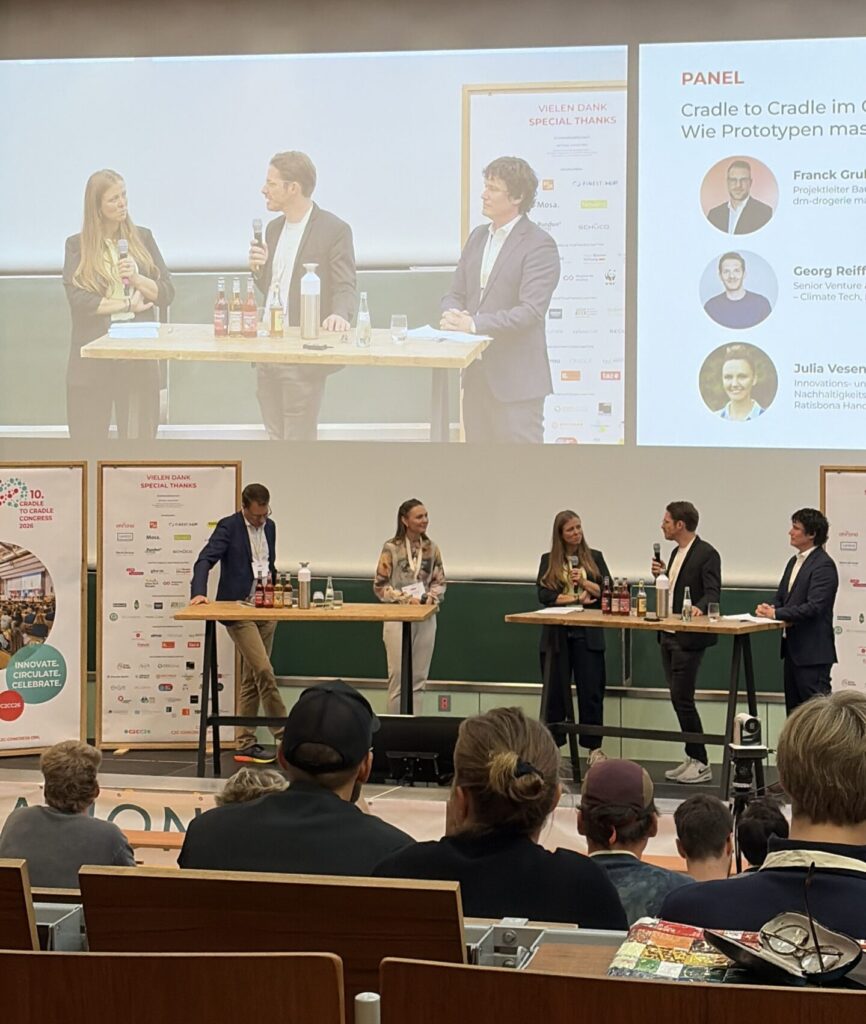
The question was even on the programme. One panel was titled
“Cradle to Cradle in commercial construction: how prototypes go mainstream”,
with dm-drogerie markt, Schwarz Group, REWE Group and the developer Ratisbona Handelsimmobilien on stage.
My answer:
circular construction in retail does not go mainstream through more prototypes, but through the remodel cycle.
A store network opens, remodels, refreshes and closes stores every year.
Each of these interventions decides whether material leaves the portfolio as waste or stays in it as value.
What is Cradle to Cradle?
The principle and what it means for store fit-outs
Cradle to Cradle© is a design principle developed in the late 1990s by the chemist Michael Braungart and the architect William McDonough (German Environment Agency, UBA). It distinguishes two cycles: a biological one for materials that can safely return to nature, and a technical one for metals, plastics and minerals that are reused again and again without loss of quality. In this logic there is no waste – only material that has not yet been returned to its next cycle.
For store fit-outs, this has an uncomfortable consequence. Standard build-ups – laminated boards, laminate flooring, glued composite panels – permanently bond materials that belong in different cycles. From a C2C perspective, they are a systemic problem.
Three terms are often used interchangeably, but they describe three different conditions:
- Disassembly: a component can be removed without damage – as a whole, functional, ready to be reinstalled.
- Separability: the joint can be undone – screwed, clamped or plugged instead of glued or pressed.
- Material purity: the material fractions can be separated from each other without loss of quality – wood from metal, metal from plastic.
The order matters: without separability, no material purity;
without material purity, no circular compatibility.
And without disassembly, recycling is the best remaining option
– the recovery route with the greatest loss of value.
Cradle to Cradle certification:
what it does for retailers – and what it doesn’t
Cradle to Cradle Certified® is a product standard, not a building standard. It is issued by the Cradle to Cradle Products Innovation Institute.
Products are assessed in five categories – material health, product circularity, clean air and climate protection, water and soil stewardship, and social fairness
– at Bronze, Silver, Gold and Platinum level. The current version is 4.1.
A store therefore cannot be C2C certified. It can be designed as C2C-inspired: built from certified products, documented in a material or building passport, and assessed through systems such as the German DGNB (C2C NGO: C2C in construction).
For retailers, this is not a drawback but the practical way in. The certification takes effect where decisions are made anyway:
in the tender specifications. Specifying C2C certified products for high-wear trades – flooring, ceiling systems, tiles, textiles – anchors material health and circularity without building an in-house testing system.
At the congress, bonprix, Royal Ahrend and EPEA discussed where this is heading: verified product data is becoming a condition for market access.
One caveat belongs here. The German Environment Agency criticises C2C for neglecting waste prevention, which ranks first in the waste hierarchy of German circular economy law
– ahead of reuse and recycling.
For existing stores, this is the decisive point: the most economical C2C product is the shelf that is already in the portfolio and does not need to be replaced.
Lighthouse projects: the demountable store is proven in new builds
Whether demountable stores can be built is no longer the question:
- dm store in Neuried (opened April 2025): timber construction from demountable timber modules, around 650 m² of sales area, ten months of construction. Unusually, dm acted as developer and owner itself.
- LOOP Markt Haimhausen (Ratisbona for EDEKA Südbayern, groundbreaking May 2026, opening planned for autumn 2026): a C2C-inspired supermarket, more than 250 products tested for material health, all materials documented in a digital circularity passport, supported by EPEA.
Projects like these are necessary. They prove feasibility, produce transferable details and supplier relationships, and set a reference standard.
But their two preconditions do not apply to most of a store portfolio: new build and ownership. Large-format retailers operate the vast majority of their stores on fixed-term leases.
They rarely decide on the building envelope. They always decide on the fit-out – from design through remodel to strip-out, regardless of who owns the building.
The manageable asset in a store portfolio is therefore not the building. It is the fit-out that is repeated store after store.
Existing stores:
why the cost impact arises in the remodel cycle
At any given time, a store portfolio is in every life cycle phase at once: one store opens while a second is remodelled and a third closes. This phase parallelism is why circularity works differently in a portfolio than in a single building. What is removed at one site is needed at another.
Then there is the pace. For my master’s thesis I interviewed eleven experts from construction departments, planning, store management, facility maintenance, finance and shopfitting. According to them, lease terms are increasingly three to five years, with some shopping centre operators demanding up to ten.
Every remodel is a partial strip-out: functional fittings are removed and replaced.
This is exactly where a valuation error arises that costs money. Store fit-outs are depreciated over five to ten years, but remodels follow the lease, remodel agreements and the CI cycle.
The two dates rarely coincide. Sometimes an open book value is written off to the P&L; sometimes functional fittings are treated as worthless because their book value is zero. Residual value recovery therefore bases the remodel decision on the material value at the time of the remodel, not on book value. I explain how this works in detail in my article Restwertrückführung
Where the value is visible, this already works. Reuse was the circular lever mentioned most often in my interviews – in seven of eleven conversations, almost always for cost reasons:
“To be honest, our goal with reuse is to save costs.”
The German grocer Tegut reused a complete CO₂ refrigeration system including all cooling units from a closed store when revitalising a store in Bad Salzschlirf, saving around EUR 500,000 and about 35 per cent of material compared with buying new (stores+shops, 2023).
What is missing is a system. High-value equipment gets relocated, the shopfitting ends up in the skip.
Every year, fixtures are
“taken out of the store, scrapped or sold to discount dealers”,
a facility maintenance manager reported. The reason rarely lies in the material, but in the joints: components are combined
“in a way that makes them economically, and sometimes technically, impossible to separate”.
(All interview quotes translated from German.)
Without separability, there is no residual value to recover.
CI and store concepts:
how disassembly fits into fixed standards
In retail, the strongest driver of premature replacement is not wear and tear but the brand. One interviewee put it in a nutshell:
“A new chair with black instead of silver legs forces you to replace everything, even though the chair still works.”
This is not an argument against CI standards. It is a design rule:
separate the base layer from the brand layer.
- Base layer – shelving systems, substructures, wall systems, carcasses, building services: durable, modular, standardised across the portfolio. It outlasts several CI generations.
- Brand layer – fronts, surfaces, colours, graphics, fascias: mechanically fixed and replaceable. A CI change only swaps this layer.
In grocery retail, this has long worked with steel shelving. Tegut has used the same modular, expandable shelving system for around 25 years; dm is developing cross-border processes to refurbish and reuse steel shelving from remodels and closures (stores+shops, 2023).
Metal shelving is separably joined, belongs to the technical cycle and is therefore circular-compatible – without anyone calling it C2C.
The hurdle is organisational. The rule belongs in the concept book and the store manual, not in the individual project. It rarely gets there because whoever pays does not decide:
“I have no influence on the concept book; that all comes from store design”,
said a facility maintenance manager.
Whoever bears the strip-out costs does not write the standard. Whoever writes the standard does not bear the strip-out costs.
Material separation in existing stores:
six levers from the next remodel onwards
No retailer switches its entire portfolio at once – and none has to.
The remodel pipeline of the next 24 months is the natural pilot group: budgeted, scheduled and due to be touched anyway.
Each of these stores is remodelled by the same rules.
- Record the stock before stripping out. A lean material passport per store is enough to start with: material type, quantity, type of joint (detachable or permanent), date of the last and the next remodel.
Where data is missing, reference values from identical stores of the same format apply.
“If I don’t even know what I’ve installed (…), I’ll never become sustainable”, said one interviewee.
The same holds economically. - Run a strip-out audit before awarding the contract. Before the strip-out, decide what is kept in place, relocated, returned to the supplier or sold.
Today, strip-outs usually go to general contractors whose fees reward fast clearance. Reuse-oriented contractors only get the job when the client explicitly asks for it. - Treat material separation as an obligation, not an extra. In Germany, the Commercial Waste Ordinance (GewAbfV, § 8) already requires construction and demolition waste to be collected separately in fractions such as glass, plastic, metal, wood and gypsum, primarily for preparation for reuse or recycling.
Above ten cubic metres of waste per project this must be documented, and any exemption must be justified by the waste producer.
Listing strip-out as a separate cost item rather than under “miscellaneous” makes disposal costs and avoided costs comparable. - Write separability into the tender specifications. Detachable joints instead of adhesives, no laminated composite boards where an alternative exists, C2C certified products for high-wear trades.
These are line items, not policy decisions. - Build take-back into framework agreements. A supplier strategy per trade, as one of the companies interviewed is currently developing, anchors take-back agreements with shopfitters and manufacturers across the portfolio instead of negotiating them project by project.
- Use the lease. Reinstatement obligations are negotiable; even in shopping centres they can often be relaxed by handing the fit-out over to the next tenant.
A green lease can go beyond energy and govern how tenant fit-outs are handled: disassembly, handover of material data, treatment of residual value.
For removed fittings to have a destination, you need a buffer – physically as a depot, or on the books as a pooled cost centre from which fittings are transferred to the receiving store.
Above a certain pace, storage becomes almost unnecessary:
in one of the portfolios studied, with around 30 new openings a year, strip-outs and reinstallations follow each other so closely that hardly anything needs to be stored.
Where the cost impact arises – and where its limits are
The economic impact of disassembly is not a spending cut
but added capacity within existing budgets. It arises in four places:
- Avoided new purchases: relocated components replace investment without tying up additional funds.
- Fewer premature write-offs: valuable fittings removed before the end of depreciation stay in use within the portfolio instead of landing in the P&L as a loss.
- Lower strip-out and disposal costs: non-destructive removal and pure material fractions reduce mixed construction waste; metal fractions have a market value.
- No mandatory extra cost: design for disassembly does not necessarily lead to higher investment costs. The additional design effort can be offset by lower strip-out and disposal costs and the recoverable residual value of the components (Heisel/Hebel 2021).
A model calculation by Arup and the Ellen MacArthur Foundation for a retail building in Berlin shows capital costs around 5 per cent lower than the linear reference case, within a range of 1 to 20 per cent
(Ellen MacArthur Foundation 2019).
The limits are part of the picture:
- Material prices: as long as new material is cheap, refurbishment loses the comparison.
“Compared with the cost of a new coated chipboard panel, it doesn’t work”, said a shopfitter.
The strategy therefore starts with durable base components, not with the chipboard front. - Transport: the environmental and economic benefit of relocation shrinks with distance. Regionally bundled relocation beats nationwide shipping.
- Portfolio size: the internal secondary market needs turnover. In small or highly heterogeneous portfolios with many shopfitting generations, it works less well.
- Data: no material passport, no valuation. That is the bottleneck, not the technology.
Conclusion:
the lighthouse sets the standard, the remodel cycle delivers the impact
For retailers, Cradle to Cradle is not a choice between a flagship project and business as usual.
The new-build lighthouse provides the standard: details, products, suppliers, data structure. The existing stores deliver the impact:
every remodel built to this standard increases the share of separable, documented and therefore recoverable fittings in the portfolio.
In many retail companies, sustainable shopfitting exists as a goal, but not as a management practice.
“The report is finished, but it really just sits there”,
one interviewee said about ESG reporting. This institutionalisation deficit runs through my interviews. Disassembly only becomes effective when it is written not into the sustainability report, but into the concept book, the tender specifications and the strip-out contract.
Which leaves one question for everyone responsible for a store portfolio: who decides on the residual value of the removed fittings at the next remodel – and on what data?